A salesforce partner is an approved company that works within the Salesforce ecosystem to deliver consulting services, build marketplace solutions, or support customers through implementation and adoption. In 2026, the decision is less about finding a generic implementation vendor and more about matching the partner’s current program track, competencies, technical delivery model, and proof of customer outcomes to your project risk.
What is a Salesforce Partner?
A salesforce partner is a business that participates in a Salesforce partner track and works with customers through a recognized ecosystem model. The two most common routes are consulting services and AgentExchange solutions. A consulting partner helps with discovery, architecture, configuration, development, testing, deployment, and adoption. An AgentExchange or ISV partner builds packaged solutions, agents, apps, components, or industry extensions that customers can evaluate through the Salesforce marketplace.
Salesforce explains the partner path in its official Partner Program and Trailhead resources. Those resources distinguish the consulting route from the product-building route, so a buyer should not use one label for every vendor. A salesforce partner that sells an app may not be the right firm to run a complex Service Cloud migration, and a consulting partner may not own a packaged product that solves a narrow requirement.
For customers, the program label is useful but incomplete. In enterprise orgs, the safer question is: Can this team prove it has delivered this kind of outcome, on this Salesforce product set, with this security and integration risk?
How does the Salesforce Partner Program work in 2026?
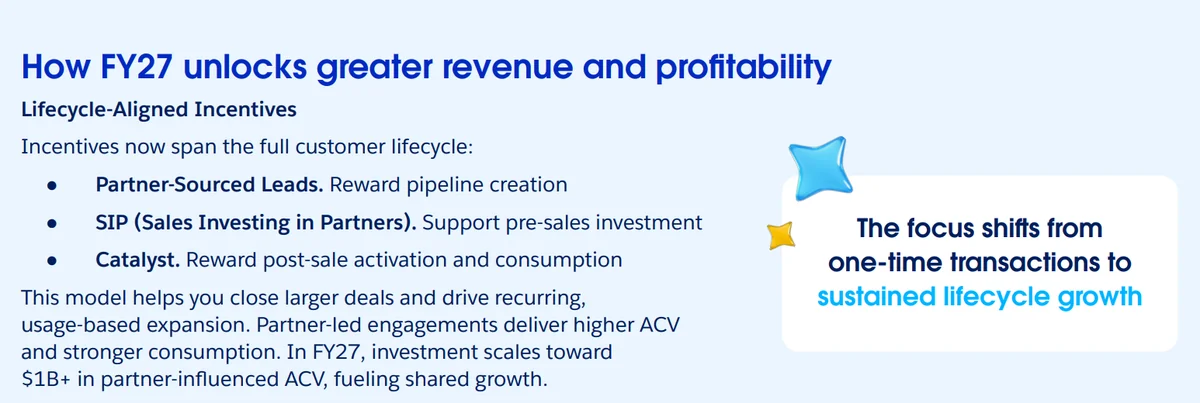
The Salesforce Partner Program gives approved partners a framework for training, marketplace presence, collaboration, and customer delivery. Salesforce’s public partner pages now emphasize Agentforce, AgentExchange, consulting delivery, and customer outcomes. The official consulting program page also describes a shift toward recognized expertise, partner dashboards, enablement access, and incentives tied to adoption across the customer lifecycle.
For a buyer, this means a salesforce partner should be evaluated by current evidence, not by a logo alone. Ask for the partner’s active marketplace profile, competencies, certifications, project examples, customer references, and the named architects who will work on your project.
Consulting partner versus AgentExchange partner
| Partner type | Main purpose | Typical buyer question | Evidence to request |
|---|---|---|---|
| Consulting partner | Plans and delivers Salesforce implementation, integration, migration, optimization, managed services, and adoption work. | Can this salesforce partner deliver our scope without creating technical debt? | Architecture samples, delivery methodology, certifications, competencies, release plan, test strategy, and references for similar work. |
| AgentExchange or ISV partner | Builds installable products, agents, apps, or components that extend Salesforce. | Does this product fit our data, security, licensing, and support requirements? | Security review status, package details, documentation, support process, data access model, and roadmap fit. |
| Combined partner model | Provides services and also offers packaged IP or accelerators. | Are we buying reusable IP, custom services, or both? | Clear SOW language for licensing, ownership, upgrade path, managed package support, and handover. |
Salesforce Partner tiers, Select, Summit, and competencies
Salesforce’s 2026 consulting program materials describe a simpler consulting track with Select and Summit tiers. The same Salesforce materials describe a move from many legacy distinctions to a smaller set of outcome-based competencies. A salesforce partner can use those competencies to show product, industry, AI, data, and delivery focus, but customers should still review the actual project record behind the label.
Competencies matter because Salesforce projects fail most often at the boundary between products: Sales Cloud to CPQ, Service Cloud to Experience Cloud, Data Cloud to Marketing Cloud, or Salesforce to ERP. A partner that has a broad credential list but no matching integration history may still be a poor fit for your scope.
Summit partner salesforce: what the tier signals
A summit partner salesforce search usually points to the Summit tier in the Salesforce Consulting Partner Program. In practical terms, that label should prompt deeper due diligence. It may indicate higher program standing, but it does not automatically prove the delivery team assigned to your project has solved your exact architecture problem.
When you review a summit partner salesforce profile, ask for the evidence behind the tier: which competencies are active, which certified specialists are allocated, how many similar projects were completed, what customer satisfaction evidence exists, and how the partner handles post-go-live adoption. A Summit label can help shortlist candidates, but the delivery plan should decide the contract. Use the exact summit partner salesforce wording only as an SEO or procurement search phrase, not as your complete evaluation method.
Use the summit partner salesforce phrase carefully in procurement notes. A summit partner salesforce profile can support a shortlist, but it should not replace a solution review. If your RFP uses summit partner salesforce as a requirement, also name the exact product scope, such as Service Cloud, Data Cloud, MuleSoft, or Agentforce.
- summit partner salesforce evidence should include current competencies, not expired badges.
- summit partner salesforce due diligence should include the named architect’s background.
- summit partner salesforce status should be checked close to contract signing because program data can change.
Global strategic partner salesforce: when global scale matters
A global strategic partner salesforce query often means the buyer wants a large delivery organization, multi-country coverage, or a partner with alliance-level experience. That may matter for global template rollouts, multi-language Experience Cloud portals, cross-region data residency reviews, or integrations across several ERP instances.
Do not treat global strategic partner salesforce as a substitute for current program validation. A global firm can bring scale, but a smaller specialist may be the better fit for a narrow Agentforce, Data Cloud, CPQ, Field Service, or Industries project. Compare the named team, not only the parent company. Use the exact global strategic partner salesforce wording as a search phrase, then validate current program records and assigned resources.
Use the global strategic partner salesforce phrase when your project needs scale, not when it only needs a tier label. A global strategic partner salesforce shortlist should still include regional delivery leads, escalation paths, and local compliance owners. If your RFP uses global strategic partner salesforce as a filter, define what global means for your program.
- global strategic partner salesforce evidence should show multi-region delivery governance.
- global strategic partner salesforce teams should explain how work moves between countries and time zones.
- global strategic partner salesforce selection should include local data handling and support coverage checks.
How to choose a Salesforce partner for enterprise delivery
Start with the outcome and work backward. A good salesforce partner selection process defines the target business process, Salesforce products, integration points, security boundaries, data volumes, migration cutover constraints, reporting needs, and adoption plan before comparing vendors.
- Define the scope in business terms. Write the measurable outcome, affected users, objects, systems, and release window. For example: reduce manual case triage for EMEA support teams while keeping entitlement checks and data residency controls intact.
- Map the product stack. Identify whether the project touches Sales Cloud, Service Cloud, Experience Cloud, CPQ, Revenue Cloud, Data Cloud, Marketing Cloud, MuleSoft, Tableau, Slack, or Agentforce.
- Check current partner evidence. Review the partner’s official Salesforce marketplace profile, competencies, certifications, project history, and customer references.
- Interview the named delivery team. Do not stop at the sales presentation. Meet the solution architect, technical architect, integration lead, data migration lead, QA lead, and release manager.
- Review delivery controls. Ask how user stories move from design to build, how code is reviewed, how deployments are automated, and how defects are triaged.
- Agree on exit criteria. Define what must be true before UAT, go-live, hypercare exit, and handover to internal admins.
Questions to ask before signing the SOW
| Area | Question | Why it matters |
|---|---|---|
| Architecture | Who owns the solution architecture decision log? | Prevents design drift and makes trade-offs visible. |
| Security | How will the team validate profiles, permission sets, sharing, CRUD, and field-level security? | Reduces data exposure and access defects after go-live. |
| Integration | What is the retry, idempotency, logging, and failure notification pattern? | Prevents silent data loss when external systems fail. |
| Data migration | What records are archived, transformed, deduplicated, and reconciled? | Protects reporting accuracy and user trust. |
| AI and Agentforce | What guardrails decide when an agent acts and when a human reviews? | Aligns automation with risk, compliance, and business policy. |
Technical checks before selecting a Salesforce partner
A salesforce partner should be able to explain implementation details without hiding behind slideware. For custom development, ask the team to show how it handles governor limits, bulk processing, sharing, CRUD and field-level security, asynchronous jobs, observability, and tests. Salesforce’s Apex documentation covers governor limits, security controls such as Security.stripInaccessible(), Queueable Apex, and the deployment requirement that Apex tests cover at least 75 percent of Apex code.
Sample Apex review item for partner due diligence
The following class is not a partner program requirement. It is an example of the kind of bulk-aware, security-aware Apex style a partner should be comfortable discussing. It performs one SOQL query, limits rows, checks object access, and strips inaccessible fields before returning records to Lightning code.
public with sharing class PartnerDeliveryHealthService {
    @AuraEnabled(cacheable=true)
    public static List<Case> getOpenHighPriorityCases(Id accountId) {
        if (accountId == null) {
            throw new AuraHandledException('Account Id is required.');
        }

        if (!Schema.sObjectType.Case.isAccessible()) {
            throw new AuraHandledException('You do not have access to Case records.');
        }

        List<Case> cases = [
            SELECT Id, CaseNumber, Subject, Status, Priority, CreatedDate
            FROM Case
            WHERE AccountId = :accountId
            AND IsClosed = false
            AND Priority = 'High'
            ORDER BY CreatedDate DESC
            LIMIT 25
        ];

        SObjectAccessDecision readableCases =
            Security.stripInaccessible(AccessType.READABLE, cases);

        return (List<Case>) readableCases.getRecords();
    }
}
Use this type of review to test how the salesforce partner thinks. A qualified team should discuss why the query is selective enough for the use case, why the method is read-only and cacheable, how record sharing is handled by with sharing, and how field access is enforced before data reaches the UI. They should also explain when Queueable Apex, Batch Apex, Platform Events, or MuleSoft would be better than synchronous Apex.
Delivery artifacts a partner should produce
- Architecture decision record: product choices, integration pattern, data ownership, security model, and rejected alternatives.
- Org strategy: sandbox plan, scratch org or source tracking approach where appropriate, deployment environments, and release gates.
- Security matrix: profiles, permission sets, permission set groups, role hierarchy, sharing rules, restriction rules where used, and field-level access.
- Integration contract: API names, authentication, data mapping, retry policy, error object, monitoring, and support ownership.
- Testing evidence: unit tests, integration tests, regression tests, UAT scripts, performance checks, and deployment validation.
- Runbook: cutover tasks, rollback plan, monitoring dashboards, hypercare contacts, and admin handover steps.
Best practices for working with a Salesforce partner
After selection, the work succeeds or fails on governance. Give the salesforce partner access to the right people, not unchecked authority over the org. Your internal product owner should approve scope decisions. Your security owner should approve access design. Your data owner should approve migration rules. Your release owner should approve deployment windows.
In enterprise orgs, set a weekly architecture checkpoint. Review open decisions, new risks, integration blockers, data defects, and scope changes. Keep this meeting separate from project status reporting. Status tells you whether work is moving. Architecture review tells you whether the team is building the right thing safely.
For a summit partner salesforce engagement, ask how the partner uses its program standing in the project: will you get named specialists, access to accelerators, early issue escalation, or product guidance? For a global strategic partner salesforce engagement, ask how global delivery is governed across time zones, languages, local compliance requirements, and handover between regional teams.
Common errors with Salesforce partner selection
- Buying the brand instead of the team. A large salesforce partner may have several practices. Validate the people assigned to your project.
- Skipping integration design. Many delays appear after teams discover that ERP, identity, data warehouse, or middleware assumptions were wrong.
- Ignoring adoption work. Training, role-based support, release notes, and business process ownership must be planned before go-live.
- Accepting vague AI scope. For Agentforce work, define data grounding, prompt instructions, action permissions, human review paths, and monitoring.
- Underestimating data migration. Data mapping, deduplication, archive decisions, and reconciliation need owners and test cycles.
- Not planning managed services. Decide who owns defects, enhancement requests, release updates, and platform monitoring after hypercare.
Official Salesforce resources to verify
Use official Salesforce sources before you make a buying decision. Start with Explore the Salesforce Partner Program, the Salesforce Consulting Partner Program, Trailhead’s Partner Program learning module, and the Salesforce Help articles for consulting partner policies and competencies. For technical review, use the Apex Developer Guide for field and object security with Security.stripInaccessible(), Queueable Apex, Apex code coverage, and Apex governor limits.
Related SalesforceTutorial resources
- Salesforce consultant roles and responsibilities
- Salesforce certification path for admins and consultants
- Salesforce implementation planning checklist
- Salesforce AppExchange and AgentExchange basics
- Agentforce in Salesforce architecture
Frequently Asked Questions
What is a Salesforce partner?
A Salesforce partner is an approved company in the Salesforce ecosystem that builds products, delivers consulting services, or both. Consulting partners help customers plan, implement, integrate, secure, and adopt Salesforce. AgentExchange partners build listed solutions that customers can install or evaluate through the Salesforce marketplace.
What does summit partner Salesforce mean?
The phrase summit partner Salesforce usually refers to the Summit tier in the Salesforce Consulting Partner Program. In the FY27 consulting program materials, Salesforce describes Summit as the higher consulting tier, while Select covers proven delivery partners that meet program standards. Customers should still verify the current listing, competencies, certifications, and project history before choosing a partner.
Is global strategic partner Salesforce a formal tier?
The phrase global strategic partner Salesforce is commonly used when people look for large partners with global delivery capacity or strategic alliance relationships. Treat it as a search term, not as a replacement for Salesforce’s current consulting tiers and competency records. Check the partner’s current marketplace profile, industry coverage, customer evidence, and delivery governance.
How do I choose the right Salesforce partner for implementation?
Start with the business outcome, then map the required Salesforce clouds, integrations, security model, data migration scope, and adoption plan. Shortlist partners whose current competencies and project history match that scope. Ask for architecture samples, release management practices, test strategy, and named delivery roles before you sign a statement of work.
Should I hire a Salesforce partner or build an internal team?
Use a Salesforce partner when the project needs delivery capacity, integration depth, industry patterns, data migration experience, or product knowledge that your internal team does not yet have. Keep internal ownership for product decisions, security approvals, data stewardship, and long-term support. The best model is often a blended team with clear handover gates.
What technical evidence should a Salesforce partner provide?
A Salesforce partner should provide evidence of bulk-safe Apex, CRUD and field-level security handling, integration monitoring, deployment automation, data migration controls, and test coverage. For projects with custom Apex, ask how the team handles governor limits, asynchronous processing, rollback plans, and the 75 percent Apex code coverage deployment requirement.