
Cloud computing characteristics define the fundamental features that distinguish cloud services from traditional on-premises solutions. Understanding these characteristics is crucial for Salesforce professionals working with Force.com, Commerce Cloud, Marketing Cloud, Service Cloud, and Data Cloud platforms. This guide covers the five essential characteristics defined by NIST (National Institute of Standards and Technology) plus additional features specific to enterprise cloud platforms like Salesforce.
The 5 Essential Cloud Computing Characteristics
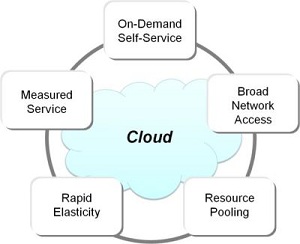
The National Institute of Standards and Technology (NIST) defines five essential characteristics that any true cloud computing service must possess. These characteristics form the foundation of all major cloud platforms, including Salesforce’s suite of cloud services.
1. On-Demand Self-Service
On-demand self-service allows users to provision computing resources automatically without requiring human interaction with service providers. In Salesforce environments:
- Force.com platform: Developers can create custom applications, deploy code, and provision sandboxes instantly through the Developer Console or VS Code
- Salesforce Commerce Cloud: Merchants can configure storefronts, add products, and modify business rules through the Business Manager interface
- Data Cloud connectors: Administrators can establish data connections to external systems using point-and-click configuration
This characteristic eliminates the traditional IT ticket system for basic provisioning tasks, enabling faster development cycles and reduced operational overhead.
2. Broad Network Access
Cloud services must be accessible over the network through standard mechanisms that support heterogeneous client platforms. Salesforce exemplifies this characteristic through:
- Multi-device support: Access via desktop browsers, mobile apps (Salesforce Mobile), tablets, and API integrations
- Global accessibility: Salesforce operates data centers worldwide, ensuring low-latency access regardless of geographic location
- Protocol support: REST APIs, SOAP APIs, Bulk APIs, and Streaming APIs enable integration with diverse systems
For example, a sales representative can update opportunity records from their mobile device while a marketing automation system simultaneously syncs lead data through REST APIs.
3. Resource Pooling
Resource pooling means the provider’s computing resources serve multiple consumers using a multi-tenant model. Physical and virtual resources are dynamically assigned and reassigned according to consumer demand.
Salesforce’s multi-tenant architecture demonstrates resource pooling through:
- Shared infrastructure: Multiple organizations share the same physical servers while maintaining data isolation
- Dynamic resource allocation: Computing power scales automatically based on usage patterns across all tenants
- Cost efficiency: Shared resources reduce per-customer costs compared to dedicated infrastructure
This pooling model enables Salesforce to serve over 150,000 customers on shared infrastructure while maintaining security and performance isolation.
4. Rapid Elasticity
Rapid elasticity refers to the ability to scale computing capabilities up or down automatically based on demand. This characteristic appears unlimited to consumers and can be appropriated in any quantity at any time.
In Salesforce environments, rapid elasticity manifests as:
- Automatic scaling: Platform handles traffic spikes during peak business periods without manual intervention
- Storage expansion: Data storage grows automatically as organizations add records, files, and users
- Processing power: Apex code execution and report generation scale based on concurrent user demand
For instance, during Black Friday sales events, Salesforce Commerce Cloud automatically provisions additional computing resources to handle increased transaction volumes without performance degradation.
5. Measured Service
Cloud systems automatically control and optimize resource usage through metering capabilities. This enables pay-per-use billing models and provides transparency for both providers and consumers.
Salesforce implements measured service through:
- Usage-based pricing: Organizations pay based on the number of users, API calls, data storage, and feature usage
- Governor limits: Built-in limits prevent any single tenant from consuming excessive shared resources
- Usage monitoring: Setup menu provides detailed usage statistics for API calls, data storage, and feature adoption
This measurement enables predictable costs and ensures fair resource distribution across all tenants in the multi-tenant environment.
Additional Cloud Computing Characteristics in Enterprise Platforms
Multi-Tenant Architecture
Multi-tenant architecture allows a single instance of software to serve multiple customers (tenants) while keeping their data isolated and secure. Each tenant’s data and configuration remain separate despite sharing the same application instance.
Salesforce’s multi-tenant model provides:
- Data isolation: Each organization’s data remains completely separate using unique organization IDs
- Customization flexibility: Organizations can customize fields, workflows, and business processes without affecting other tenants
- Shared updates: All tenants receive platform updates simultaneously, ensuring consistent feature availability
Service-Level Agreements (SLAs)
Enterprise cloud platforms provide guaranteed uptime and performance metrics through formal SLAs. Salesforce maintains a 99.9% uptime commitment with real-time status monitoring available at trust.salesforce.com.
Cloud Computing Characteristics in Salesforce Products
Salesforce Commerce Cloud Tutorial Applications
Commerce Cloud demonstrates cloud computing characteristics through:
- Global scalability: Handles millions of concurrent shoppers during peak seasons
- Elastic infrastructure: Automatically scales based on traffic patterns and geographic demand
- Self-service management: Merchants configure products, pricing, and promotions without technical support
Salesforce Marketing Cloud and Inbound Email Processing
Marketing Cloud showcases cloud characteristics when processing inbound emails:
- Automatic processing: Inbound emails trigger automated workflows without manual intervention
- Scalable throughput: Handles varying email volumes based on campaign schedules and customer responses
- Measured usage: Tracks email processing volumes for billing and capacity planning
Yes, Salesforce Marketing Cloud does work on inbound emails through Email Studio’s reply mail management and Journey Builder’s email event triggers.
Salesforce Service Cloud Tutorial Features
Service Cloud exemplifies cloud computing characteristics through:
- Omnichannel routing: Automatically distributes cases across available agents based on skills and capacity
- Knowledge base scaling: Supports unlimited articles with automatic search indexing and relevance ranking
- Integration capabilities: Connects with telephony systems, chat platforms, and social media channels through standard APIs
Data Cloud Tutorial and Connector Architecture
Salesforce Data Cloud demonstrates advanced cloud characteristics:
- Real-time data processing: Ingests and processes streaming data from multiple sources simultaneously
- Elastic storage: Scales data storage automatically based on ingestion volumes and retention policies
- Self-service connectors: Administrators configure data connections through point-and-click interfaces
Data Cloud connectors support over 100 pre-built integrations with popular business applications, enabling rapid data unification without custom development.
Salesforce Commerce Cloud Interview Questions Context
Understanding cloud computing characteristics helps answer common Salesforce Commerce Cloud interview questions:
- Scalability questions: Explain how elastic infrastructure handles traffic spikes during promotional events
- Multi-tenancy questions: Describe how shared resources reduce costs while maintaining security isolation
- Integration questions: Discuss how broad network access enables omnichannel customer experiences
Force.com Platform and Cloud Computing
Force.com in cloud computing represents a Platform-as-a-Service (PaaS) offering that embodies all five essential cloud characteristics:
- Development environment: Developers provision development environments instantly without infrastructure setup
- Deployment automation: Code deployments happen automatically through change sets or CI/CD pipelines
- Resource sharing: Multiple development teams share platform resources while maintaining project isolation
- Usage-based pricing: Organizations pay based on active users and platform feature consumption
Best Practices for Leveraging Cloud Computing Characteristics
Optimize for Elasticity
- Design applications to handle variable loads gracefully
- Use asynchronous processing for non-time-critical operations
- Implement proper error handling for resource constraints
Maximize Self-Service Capabilities
- Train users on platform self-service features to reduce support tickets
- Create custom applications that enable business users to manage their own data
- Implement approval processes that automate routine administrative tasks
Monitor Resource Usage
- Regularly review governor limit usage to prevent unexpected constraints
- Set up monitoring alerts for API usage, storage consumption, and user adoption
- Optimize queries and processes to minimize resource consumption
Frequently Asked Questions
What are the 5 essential cloud computing characteristics?
The 5 essential cloud computing characteristics defined by NIST are: on-demand self-service, broad network access, resource pooling, rapid elasticity, and measured service. These characteristics distinguish true cloud services from traditional hosting or software delivery models.
How does Force.com demonstrate cloud computing characteristics?
Force.com demonstrates all five cloud characteristics through instant development environment provisioning (on-demand self-service), multi-device API access (broad network access), shared multi-tenant infrastructure (resource pooling), automatic scaling during peak usage (rapid elasticity), and usage-based pricing models (measured service).
Does Salesforce Marketing Cloud work on inbound emails?
Yes, Salesforce Marketing Cloud processes inbound emails through Email Studio’s reply mail management feature and Journey Builder’s email event triggers. Inbound emails can trigger automated workflows, update contact records, and initiate customer journeys based on email content and sender information.
What are Salesforce Data Cloud connectors?
Salesforce Data Cloud connectors are pre-built integrations that enable real-time data synchronization between Salesforce and external systems. They support over 100 popular business applications and demonstrate cloud characteristics through self-service configuration, elastic data processing, and measured usage billing.
How does multi-tenant architecture work in Salesforce?
Multi-tenant architecture in Salesforce allows multiple organizations to share the same application instance while maintaining complete data isolation. Each tenant receives their own organization ID, custom configurations, and security settings, but shares underlying infrastructure resources for cost efficiency and automatic updates.
What cloud computing characteristics should I mention in Commerce Cloud interviews?
In Commerce Cloud interviews, emphasize rapid elasticity for handling traffic spikes during sales events, multi-tenant architecture for cost-effective scaling, broad network access for omnichannel experiences, and measured service for predictable pricing. Provide specific examples of how these characteristics benefit e-commerce operations.